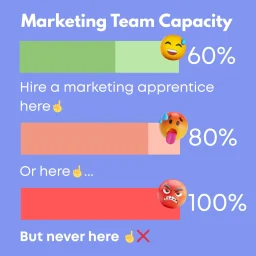
This is the question a lot of founders are really asking:
“When does the time investment start turning into actual output?”
It’s a fair concern. Hiring a marketing apprentice isn’t just about salary; it’s about the time, energy, and attention required to get them up to speed.
Let’s be clear from the outset. A marketing apprentice is not going to walk in on day one and start delivering high-performing campaigns. If that’s the expectation, you may need a swift head rattle.
At the same time, though, they’re not a six-month dead investment either. That assumption is just as off.
The reality sits somewhere in the middle — and it’s far more practical than people expect.
What Actually Determines How Quickly They Become Useful?
There isn’t a fixed timeline. The speed at which an apprentice becomes productive depends on a handful of variables:
Their starting point
Someone with a degree or light hands-on experience will ramp faster than someone completely new to marketing.
The structure you give them
Clear, defined tasks will always outperform vague “have a go” instructions. Lack of direction slows everything down.
The training alongside the role
This is where a strong provider matters. Good training reduces guesswork and builds confidence quickly.
Your involvement early on
A bit of upfront time — setting expectations, reviewing work, giving feedback — saves weeks of inefficiency later.
Get these right and progress is steady. Get them wrong and everything drags.
What “Useful” Actually Means
A common mistake is expecting apprentices to think like strategists too early. That’s not their job.
At the start, their value comes from execution; taking repeatable, time-consuming tasks off your plate so you and your team can focus on higher-level work.
“Useful” doesn’t mean perfect. It means they can contribute, produce, and keep things moving.
What Initial Progress Typically Looks Like
In most cases, the first three months follow a fairly predictable pattern.
Weeks 1–4
This is onboarding territory. They’re learning your business, your tools, your tone of voice, and how things are done. Output is light and heavily guided.
Weeks 4–8
They begin producing usable work. This usually includes social content, basic email campaigns, research tasks, and supporting activity across channels.
Weeks 8–12
At this point, they start to resemble a junior team member. They can handle day-to-day marketing tasks with less input, maintain consistency, and reduce pressure on the wider team.
This is typically where the shift happens, from “training” to “contributing.”
What They Can Do at 3, 6, and 12 Months
Beyond the initial ramp-up, capability tends to build quickly if the environment is right.
Around 3 months
They’re operating as a reliable doer.
You can expect them to:
- Manage routine content creation (social posts, blogs, emails)
- Follow processes without constant supervision
- Support campaign delivery with defined tasks
- Handle basic reporting and data tracking
They still need a bit of direction, but they’re no longer dependent.
Around 6 months
This is where confidence and consistency really kick in.
They’ll typically be able to:
- Take ownership of smaller campaigns or channels
- Make informed decisions within a defined scope
- Contribute ideas, not just execute tasks
- Work more independently across tools like CRM, email platforms, and analytics
They’re still developing, but they’re now adding clear, measurable value.
Around 12 months
Now you’re looking at a well-rounded junior marketer.
At this stage, they can:
- Plan and execute campaigns with minimal input
- Interpret data and adjust activity accordingly
- Manage ongoing marketing activity end-to-end
- Support broader strategic discussions (with guidance)
They’re no longer just supporting the function — they’re part of it.
So, When Do They Become “Useful”?
With the right setup, most apprentices become meaningfully useful within 2–3 months. Not flawless. Not fully independent. But capable enough to contribute, reduce workload, and justify the investment.
The Bottom Line
If you need immediate impact, hire experience. If you want to build capacity, develop talent, and create long-term value, an apprentice is a strong option. The key is expectation. Treat them like a long-term asset, give them structure early, and you’ll see the return far sooner than most people expect.
Worried about how long it’ll take for an apprentice to actually contribute?
With the right setup, most are adding real value within 2–3 months.
If you’re looking to build capacity without overloading your team, we’ll show you how to get it right from day one.
Fill in the form, and we’ll talk you through what that could look like in your business.
Email: info@themarketingtrainer.co.uk
Call: 03301 338666